> ## Documentation Index
> Fetch the complete documentation index at: https://docs.vaultline.dev/llms.txt
> Use this file to discover all available pages before exploring further.
# Auditability
Auditability is the ability of a system to provide a complete, accurate, and verifiable record of its behavior.
In VaultLine, auditability is not a feature added for compliance.
It is a foundational capability designed to ensure **trust in the system itself**.
***
## Why Auditability Matters
As systems grow in complexity, the hardest problems are not about execution —
they are about understanding.
At any point in time, a system must be able to answer:
* What happened?
* Why did it happen?
* What state did it produce?
* Can that state be trusted?
Without clear answers, even well-built systems become:
* Difficult to debug
* Hard to verify
* Risky to operate
A system that cannot explain itself cannot be trusted.
***
## The Problem with Traditional Systems
In most architectures, auditability is treated as an afterthought.
It is often implemented as:
* Logs generated after execution
* External monitoring tools
* Periodic compliance reports
These approaches create a fragmented view of the system.
Common issues include:
* Incomplete or missing logs
* Lack of connection between events
* Inability to reconstruct full system behavior
This results in:
* Limited transparency
* Increased operational risk
* Reduced confidence in outcomes
The system may function —
but its behavior remains partially invisible.
***
## The VaultLine Approach
VaultLine treats auditability as a **core system property**, not an external layer.
Every action in the system is designed to be:
* Recorded
* Traceable
* Contextual
Not just *what happened*, but:
\> **Why it happened, how it happened, and what it affected**
Auditability is not something you query later.
It is something the system continuously maintains.
***
## Core Principles
### 1. Complete Traceability
Every operation in the system can be traced from origin to outcome.
This ensures:
* Clear visibility into system behavior
* No hidden transitions
* No unexplained results
Every action leaves a trace that can be followed.
***
### 2. Contextual Understanding
Events are not stored in isolation.
Each action is recorded along with:
* Its context
* Its relationship to other events
* The system state at that moment
This transforms raw logs into meaningful system narratives.
***
### 3. Verifiable History
The system maintains a consistent and reliable history of events.
This enables:
* Validation of system outcomes
* Independent verification
* Confidence in correctness
The system does not just store history —
it preserves **truth over time**.
***
### 4. Continuous Audit Readiness
Auditability is not activated when needed.
The system is always:
* Recording events
* Structuring information
* Maintaining traceability
This ensures:
\> The system is always ready to explain itself.
***
## How Auditability Works
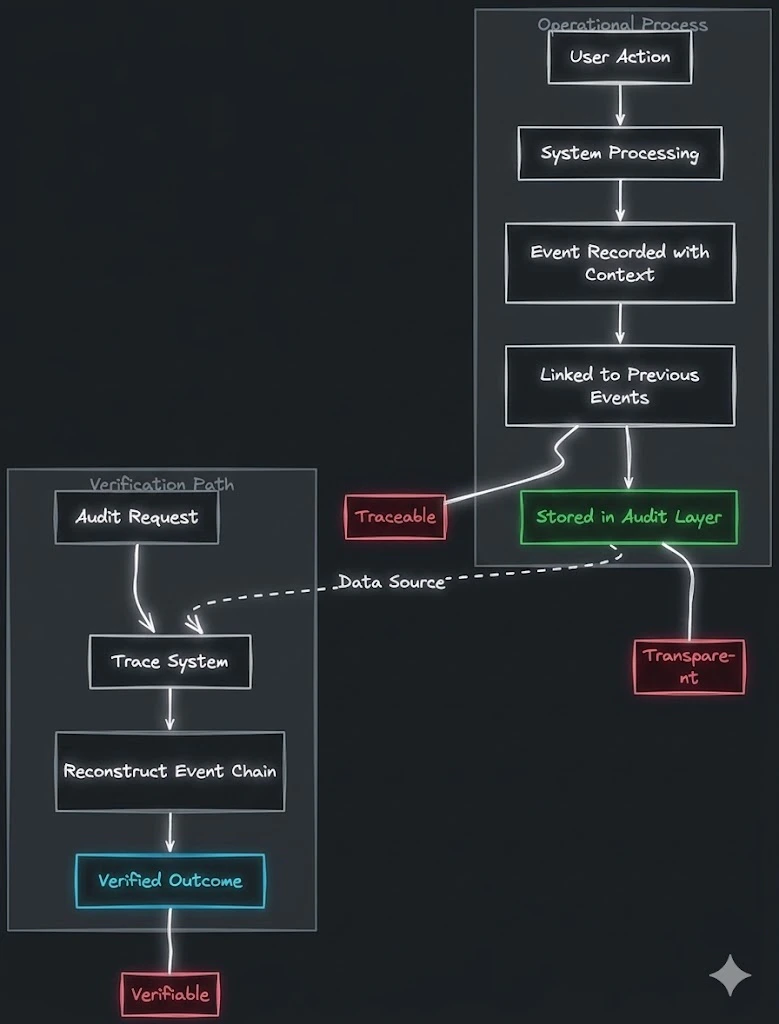 This flow illustrates how VaultLine treats every action as part of a traceable system narrative:
* Each event is captured with context
* Events are linked into a continuous chain
* The system maintains relationships between actions
When an audit or investigation is required:
* The system reconstructs the full sequence of events
* Identifies cause-and-effect relationships
* Verifies outcomes against recorded history
There is no need for guesswork.
***
## System Behavior
When an event occurs in VaultLine:
* It is recorded with its full context
* Linked to prior and subsequent system actions
* Stored in a structured, traceable format
If an issue arises:
* The complete chain of events can be reconstructed
* The system can explain its behavior step-by-step
* Decisions can be validated with confidence
The system does not just operate —
it **explains itself continuously**.
***
## Trust as a System Property
Auditability transforms trust from an assumption into a property.
Instead of asking:
\> “Do we trust the system?”
VaultLine enables:
\> “We can verify the system.”
This shift is critical for:
* Financial systems
* Compliance-heavy environments
* High-stakes decision systems
***
## Why it matters
Without auditability:
* Systems become opaque
* Debugging becomes guesswork
* Compliance becomes reactive
* Trust gradually erodes
With VaultLine:
* Every action is explainable
* System behavior is transparent
* Outcomes are verifiable
* Trust is built into the system
***
## Key Takeaway
Auditability is not about storing logs.
It is about building systems where:
\> Every action can be understood, every decision can be verified, and every outcome can be trusted.
This flow illustrates how VaultLine treats every action as part of a traceable system narrative:
* Each event is captured with context
* Events are linked into a continuous chain
* The system maintains relationships between actions
When an audit or investigation is required:
* The system reconstructs the full sequence of events
* Identifies cause-and-effect relationships
* Verifies outcomes against recorded history
There is no need for guesswork.
***
## System Behavior
When an event occurs in VaultLine:
* It is recorded with its full context
* Linked to prior and subsequent system actions
* Stored in a structured, traceable format
If an issue arises:
* The complete chain of events can be reconstructed
* The system can explain its behavior step-by-step
* Decisions can be validated with confidence
The system does not just operate —
it **explains itself continuously**.
***
## Trust as a System Property
Auditability transforms trust from an assumption into a property.
Instead of asking:
\> “Do we trust the system?”
VaultLine enables:
\> “We can verify the system.”
This shift is critical for:
* Financial systems
* Compliance-heavy environments
* High-stakes decision systems
***
## Why it matters
Without auditability:
* Systems become opaque
* Debugging becomes guesswork
* Compliance becomes reactive
* Trust gradually erodes
With VaultLine:
* Every action is explainable
* System behavior is transparent
* Outcomes are verifiable
* Trust is built into the system
***
## Key Takeaway
Auditability is not about storing logs.
It is about building systems where:
\> Every action can be understood, every decision can be verified, and every outcome can be trusted.