> ## Documentation Index
> Fetch the complete documentation index at: https://docs.vaultline.dev/llms.txt
> Use this file to discover all available pages before exploring further.
# Failure First Design
VaultLine is built on a simple but critical assumption:
\> Failure is not rare. It is constant.
Modern systems are complex, distributed, and unpredictable.
Networks fail. Services go down. Data arrives out of order. Dependencies behave unexpectedly.
Failure is not a possibility.
It is the environment.
***
## The Problem with Traditional Thinking
Most systems are designed with an implicit assumption:
\> “Things will work as expected.”
Failure is treated as:
* An edge case
* A rare exception
* Something to handle later
This leads to systems that:
* Work well under ideal conditions
* Break under stress
* Require manual intervention during failure
When something goes wrong, the system shifts from:
\> predictable → reactive → chaotic
***
## The Cost of Ignoring Failure
When failure is not part of the design:
* Systems enter inconsistent states
* Debugging depends on human interpretation
* Recovery becomes slow and uncertain
* Trust in the system degrades
The system may come back online —
but correctness is no longer guaranteed.
***
## The VaultLine Shift
VaultLine changes the fundamental question.
Instead of asking:
\> “How do we avoid failure?”
It asks:
\> “How do we remain correct even when failure happens?”
This is the foundation of failure-first design.
***
## What Failure-First Design Means
Failure-first design treats failure as a **design input**, not an afterthought.
Every part of the system is built with these assumptions:
## Traditional vs Failure-First Systems
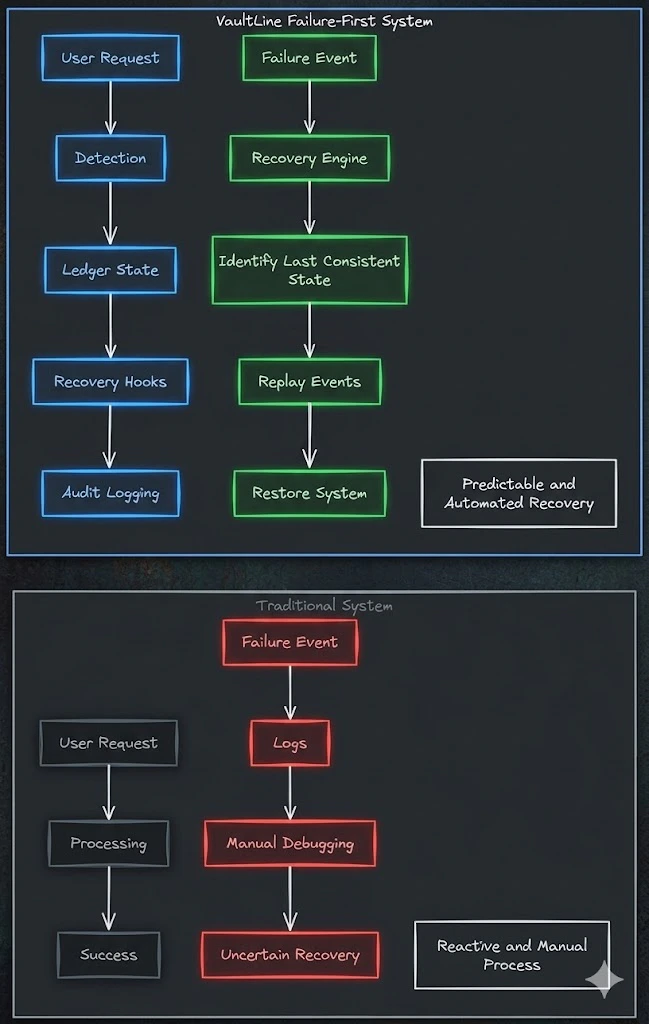 * Failure will happen
* It may happen at any step
* It may happen partially
* It may happen repeatedly
The goal is not to eliminate failure.
The goal is to ensure:
\> Failure never compromises system correctness.
***
## System Behavior Under Failure
In a failure-first system, when something breaks:
* The system detects the issue early
* The current state remains consistent
* The failure is contained
* Recovery is triggered automatically
* The system returns to a correct state
There is no panic.
There is no ambiguity.
The system behaves in a **controlled and explainable way**.
***
## Design Principles
### 1. Assume Failure at Every Step
Every operation is designed with the possibility of failure.
Not just total failure — but partial, delayed, or inconsistent execution.
***
### 2. Make State Observable
The system always knows:
* What has happened
* What is happening
* What should happen next
This removes guesswork during recovery.
***
### 3. Prepare Recovery in Advance
Recovery is not designed during failure.
It is built into the system beforehand.
Every operation carries:
* Context
* Traceability
* Recovery pathways
***
### 4. Contain Failure
Failures do not spread uncontrollably.
They are isolated so that:
* One component failing does not break everything
* The rest of the system remains stable
***
### 5. Keep the System Deterministic
Even under failure:
* The system behaves predictably
* Outcomes are consistent
* State transitions are controlled
***
## Failure is a State, Not an Event
Traditional systems treat failure as a moment.
VaultLine treats failure as a **state the system can operate within**.
This means:
* The system continues to function
* Integrity is preserved
* Recovery happens as part of normal operation
***
## What Makes This Different
Most systems aim for:
* High availability
* Fast performance
VaultLine prioritizes:
* **Correctness under failure**
Because:
\> A fast system that produces incorrect results is more dangerous than a slow system that is correct.
***
## Why it matters
Without failure-first design:
* Systems behave unpredictably under stress
* Failures create cascading issues
* Recovery becomes increasingly difficult
With VaultLine:
* Failures are expected
* Behavior is controlled
* Recovery is predictable
* Systems remain trustworthy
***
## Key Takeaway
Failure-first design is not about expecting the worst.
It is about engineering systems that remain correct, stable, and trustworthy —
even when everything does not go as planned.
\> Failure is not the problem.
\> Uncontrolled systems are.
* Failure will happen
* It may happen at any step
* It may happen partially
* It may happen repeatedly
The goal is not to eliminate failure.
The goal is to ensure:
\> Failure never compromises system correctness.
***
## System Behavior Under Failure
In a failure-first system, when something breaks:
* The system detects the issue early
* The current state remains consistent
* The failure is contained
* Recovery is triggered automatically
* The system returns to a correct state
There is no panic.
There is no ambiguity.
The system behaves in a **controlled and explainable way**.
***
## Design Principles
### 1. Assume Failure at Every Step
Every operation is designed with the possibility of failure.
Not just total failure — but partial, delayed, or inconsistent execution.
***
### 2. Make State Observable
The system always knows:
* What has happened
* What is happening
* What should happen next
This removes guesswork during recovery.
***
### 3. Prepare Recovery in Advance
Recovery is not designed during failure.
It is built into the system beforehand.
Every operation carries:
* Context
* Traceability
* Recovery pathways
***
### 4. Contain Failure
Failures do not spread uncontrollably.
They are isolated so that:
* One component failing does not break everything
* The rest of the system remains stable
***
### 5. Keep the System Deterministic
Even under failure:
* The system behaves predictably
* Outcomes are consistent
* State transitions are controlled
***
## Failure is a State, Not an Event
Traditional systems treat failure as a moment.
VaultLine treats failure as a **state the system can operate within**.
This means:
* The system continues to function
* Integrity is preserved
* Recovery happens as part of normal operation
***
## What Makes This Different
Most systems aim for:
* High availability
* Fast performance
VaultLine prioritizes:
* **Correctness under failure**
Because:
\> A fast system that produces incorrect results is more dangerous than a slow system that is correct.
***
## Why it matters
Without failure-first design:
* Systems behave unpredictably under stress
* Failures create cascading issues
* Recovery becomes increasingly difficult
With VaultLine:
* Failures are expected
* Behavior is controlled
* Recovery is predictable
* Systems remain trustworthy
***
## Key Takeaway
Failure-first design is not about expecting the worst.
It is about engineering systems that remain correct, stable, and trustworthy —
even when everything does not go as planned.
\> Failure is not the problem.
\> Uncontrolled systems are.