> ## Documentation Index
> Fetch the complete documentation index at: https://docs.vaultline.dev/llms.txt
> Use this file to discover all available pages before exploring further.
# Recoverability
Recoverability is the ability of a system to return to a correct, consistent, and trusted state after a failure.
In VaultLine, recovery is not a fallback mechanism — it is a **first-class system capability**.
Systems are not designed assuming success.
They are designed assuming that failure will happen — and must be handled predictably.
***
## Why Recoverability Matters
Modern systems are distributed, asynchronous, and complex.
Failures are not rare events — they are inevitable:
* Network interruptions
* Partial service outages
* Data inconsistencies
* Unexpected edge cases
* External dependency failures
Most systems treat these as exceptions.
VaultLine treats them as **normal operating conditions**.
***
## The Problem with Traditional Systems
In most architectures, recovery is reactive and unclear:
* Logs are inspected after failure
* Engineers manually debug issues
* State inconsistencies are hard to trace
* Recovery paths are undefined or ad-hoc
This leads to:
* ❌ Data corruption or drift
* ❌ Long recovery times
* ❌ Hidden system inconsistencies
* ❌ Compliance and audit failures
The system may come back online — but **trust is already broken**.
***
## VaultLine Approach
VaultLine builds systems where recovery is **designed, not improvised**.
Every action in the system is:
* Recorded → nothing is lost
* Traceable → everything can be understood
* Replayable → state can be rebuilt
Recovery is not:
\> “What do we do after failure?”
Recovery is:
\> “How do we guarantee correctness despite failure?”
***
## Core Principles of Recoverability
### 1. Deterministic Recovery
Recovery is not guesswork.
For every failure scenario:
* The recovery path is predefined
* The outcome is predictable
* The system behaves consistently
***
### 2. Replayable State
The system does not rely on current state alone.
Instead:
* All events are recorded
* State can be reconstructed from history
This enables:
* Debugging past failures
* Rebuilding corrupted states
* Verifying system correctness
***
### 3. Failure Isolation
Failures are contained within boundaries.
Instead of cascading:
* A failed component does not break the entire system
* Recovery happens locally where possible
***
### 4. Continuous Recovery Readiness
Recovery is not triggered only during failure.
The system is always:
* Recording events
* Maintaining checkpoints
* Preparing recovery paths
This means:
\> The system is always ready to recover — instantly.
***
## Recovery Flow (Conceptual)
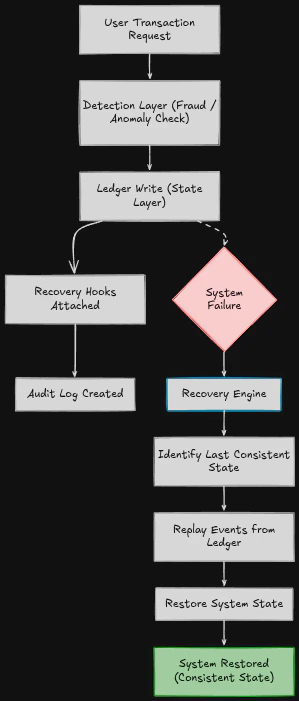
A transaction in VaultLine is never just processed — it is **prepared for recovery at every step**.\
\\
### System-Level Recovery Flow
 \
\
\\
1. Transaction enters system
2. System records the intent
3. Detection layer evaluates anomalies
4. State update is written to ledger
5. Recovery hooks are attached
6. Audit trail is stored
If failure occurs at any stage:
* The system identifies the last consistent state
* Replays events if needed
* Restores correctness deterministically
***
## What Makes VaultLine Different
Traditional systems aim for:
\> High availability
VaultLine ensures:
\> **Correctness under failure**
This is a fundamental shift.
***
## Why it matters
Without recoverability:
* Systems silently drift into inconsistent states
* Failures compound over time
* Debugging becomes harder
* Trust erodes
With VaultLine:
* Recovery is fast
* Outcomes are predictable
* State remains consistent
* Systems remain trustworthy
***
## Key Takeaway
Recoverability is not about fixing failures.
It is about designing systems where:
\> Failure never compromises correctness.
\
\
\\
1. Transaction enters system
2. System records the intent
3. Detection layer evaluates anomalies
4. State update is written to ledger
5. Recovery hooks are attached
6. Audit trail is stored
If failure occurs at any stage:
* The system identifies the last consistent state
* Replays events if needed
* Restores correctness deterministically
***
## What Makes VaultLine Different
Traditional systems aim for:
\> High availability
VaultLine ensures:
\> **Correctness under failure**
This is a fundamental shift.
***
## Why it matters
Without recoverability:
* Systems silently drift into inconsistent states
* Failures compound over time
* Debugging becomes harder
* Trust erodes
With VaultLine:
* Recovery is fast
* Outcomes are predictable
* State remains consistent
* Systems remain trustworthy
***
## Key Takeaway
Recoverability is not about fixing failures.
It is about designing systems where:
\> Failure never compromises correctness.